Why AI Companies Are Destroying Books
There is something quietly dystopian about watching the companies building the future of intelligence treat the past of human knowledge as disposable feedstock.
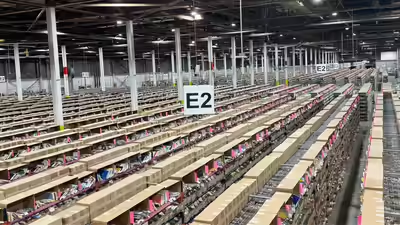
In recent years, leading AI labs have bought physical books by the millions. They cut the spines, feed the loose pages through high-speed scanners, extract the text, and discard or recycle what remains. Anthropic’s internal project, code-named Panama, was described in company documents as an effort to “destructively scan all the books in the world.” Other players have turned to middlemen and bulk suppliers operating under strict nondisclosure agreements so the optics never attach directly to a familiar brand name. Pre-2022 print is especially prized: it is dense, edited, and free of the synthetic “slop” that now contaminates much of the open web.
The motive is straightforward and relentless. Frontier models are data-hungry. High-quality, long-form, human-written text remains one of the most valuable remaining resources. When licensing at scale proves difficult or expensive, and when shadow libraries carry legal risk, the physical second-hand market becomes the path of least resistance. Buy the object, destroy the object, keep the tokens. Courts have even treated the one-for-one replacement of a purchased print copy with an internal digital file as transformative fair use in certain cases. Legally tidy. Culturally corrosive.
Acquisition without stewardship
This is not digitization in the spirit of a public library or a national archive. It is extraction. The resulting corpus is not opened to scholars, readers, or future generations. It is folded into proprietary model weights and made available only through the company’s interface—chat, API, or licensed product. You do not get the book. You get a probabilistic echo of the book, shaped by whatever objectives the lab optimized for, filtered by safety layers, and gated behind terms of service that can change tomorrow.
Knowledge is not being preserved. It is being digested.
A book is more than a sequence of tokens. It carries authorship, context, physical evidence of its time, the possibility of citation, disagreement, and re-reading against the original. Once the pages are gone and the only remaining representation lives inside a neural network, that original is no longer independently accessible. What survives is a statistical average optimized for next-token prediction and commercial usefulness. The difference between a library and a model is the difference between an archive and a digestion chamber.
The deeper warning
The same logic that treats books as consumable training material already treats the rest of the information landscape the same way. Personal data, private conversations, professional writing, scientific papers, creative work—anything that can be scraped, purchased, or inferred becomes fuel. The drive is the same: acquire as much as possible, transform it into internal capability, and mediate access through the service that owns the resulting system.
When originals disappear or become inaccessible, the integrity of information itself is at risk. Future claims about what was written, who said it, or what the evidence actually showed will rest increasingly on systems whose training data and internal representations are opaque, mutable, and controlled by a handful of organizations. Privacy follows the same pattern. Once the presumption is that every signal is fair game for ingestion, the boundary between public knowledge and private life erodes. The book is only the most visible and culturally charged example.
We do not have to reject AI to reject this particular relationship to knowledge. Digitization that leaves the original intact, licensing that respects authors, open archives that remain independently queryable, and clear limits on what may be absorbed without consent are all possible. What we cannot afford is the quiet normalization of a model in which the highest-quality records of human thought are purchased, destroyed, and reconstituted solely as proprietary capability.
The companies racing to build more powerful systems are, in the process, deciding what forms of knowledge will remain independently available to the rest of us. That decision should not be left to industrial convenience and legal technicalities alone. The integrity of information—and the privacy that protects the conditions under which new information can still be created—depends on refusing to treat the record of human thought as just another input to be consumed.